What the treatment is, and what a day looks like
An outpatient therapy that removes the cholesterol particles driving your cardiovascular risk. No surgery, no hospital stay, no downtime.
A filter for the cholesterol medication can't reach.
Lipoprotein apheresis is a blood-filtering therapy, closely related to dialysis. Instead of removing waste products, it removes lipoprotein(a), LDL, and ApoB, the particles that build plaque in your arteries. It is used for patients whose cholesterol stays dangerously high despite maximum medication, and for those with genetic conditions like familial hypercholesterolemia or elevated Lp(a).
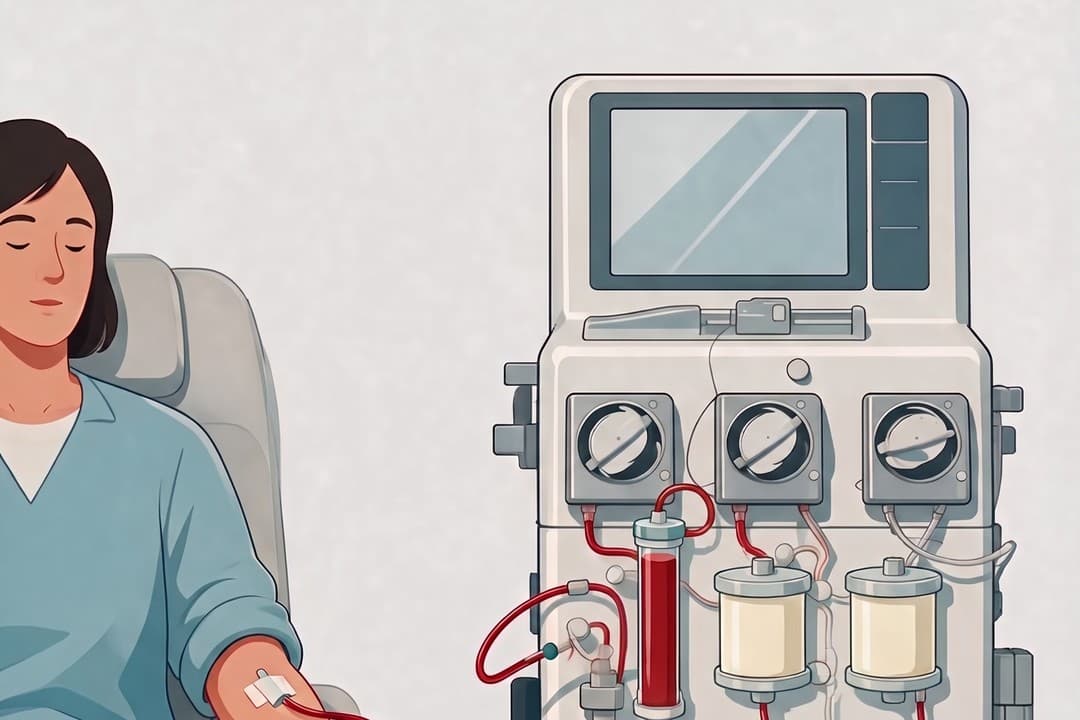
What actually happens.
Most patients settle into a routine after the first two or three visits.
Check in
Weight, blood pressure, and a quick check-in with your nurse. About 15 minutes.
Get comfortable
You recline; two small IVs are placed, one in each arm. Blankets, Wi-Fi, and a screen are there if you want them.
Two to four hours
Read, watch something, listen, or sleep. Your nurse monitors you the whole time.
Go home
IVs come out, a short observation, and you're done.
Practical facts, plainly stated.
| Is it painful? | The IV placement is a brief pinch. The treatment itself is not painful. Most patients describe it as uneventful. |
|---|---|
| How often? | Usually every one to two weeks, on an ongoing basis, based on your labs and your cardiologist's guidance. |
| How we get access | Most patients are treated through a small IV in each arm: one to draw blood out, one to return it. If your veins make that difficult, or you already have a port, a central catheter or a dialysis fistula, we can use that instead. |
| Side effects | Most sessions are uneventful. The effects patients report most often are lightheadedness, a temporary drop in blood pressure, and bruising or tenderness at the IV site. |
| Medications to tell us about | Important: ACE inhibitors, a widely prescribed class of blood-pressure medication, cannot be taken alongside this treatment. Combined with the columns we use, they can cause a serious reaction. This is manageable and routine: we work with your physician to switch you to an alternative such as an ARB, and there is a washout period before you begin. Bring your complete medication list to your consultation so we can sort this out well ahead of your first session. |
| Can I eat beforehand? | Yes. We encourage a normal meal and good hydration before your session. |
| Getting home | Many patients drive themselves. Because blood pressure can dip, plan to have someone available after your first session. |
| Is it covered? | Medicare and many commercial plans cover apheresis for qualifying patients. We verify your benefits before you begin. |
Bring a book. The machine does the work.
Candidates we most often treat.
Where medication cannot lower Lp(a) meaningfully.
Heterozygous or homozygous, above goal on maximum therapy.
Patients who cannot tolerate the doses their risk level requires.
Continued events or plaque progression on optimal medical therapy.
Not sure whether you qualify? That’s what the consult is for.
We review your labs, history, and coverage and give you a straight answer.