Your cholesterol is high. Your medication isn’t enough. There’s another option.
Lipoprotein apheresis filters the harmful cholesterol particles that statins can’t touch, measurably, session by session, with results no medication can match.
Most people with high Lp(a) have never been told about it.
Lipoprotein(a) is a cholesterol particle set almost entirely by your genetics. Statins, diet, and exercise barely move it, yet it independently raises your risk of heart attack, stroke, and aortic valve disease. If your panel “looks normal” but heart disease runs in your family, this is often what’s been missed.
Measurable reduction, when medication has plateaued.
Each session physically removes the particles driving cardiovascular risk.
Removes harmful particles
Lp(a), LDL, and ApoB reduced by 65–85% in a single session.
Quiets the arteries
Lowers inflammation and clot-promoting factors in the blood.
Protects the heart
Improves microvascular function. May slow the progression of plaque.
One condition, and two things that qualify alongside it.
Apheresis is approved for inherited high cholesterol. Elevated Lp(a) and peripheral artery disease matter because of how they combine with it.
Familial hypercholesterolemia
Inherited high cholesterol, present from birth and frequently missed for decades. This is the condition apheresis is approved to treat, and every indicated patient group is a form of it.
About FH →Elevated Lp(a)
A cholesterol particle set by your genetics that statins barely move, and that a standard panel does not measure. With FH and documented vascular disease, it qualifies you for treatment.
About Lp(a) →PAD and wounds that will not heal
Circulation too poor for another stent or bypass. Documented peripheral artery disease is a qualifying condition when it comes with inherited high cholesterol or high Lp(a).
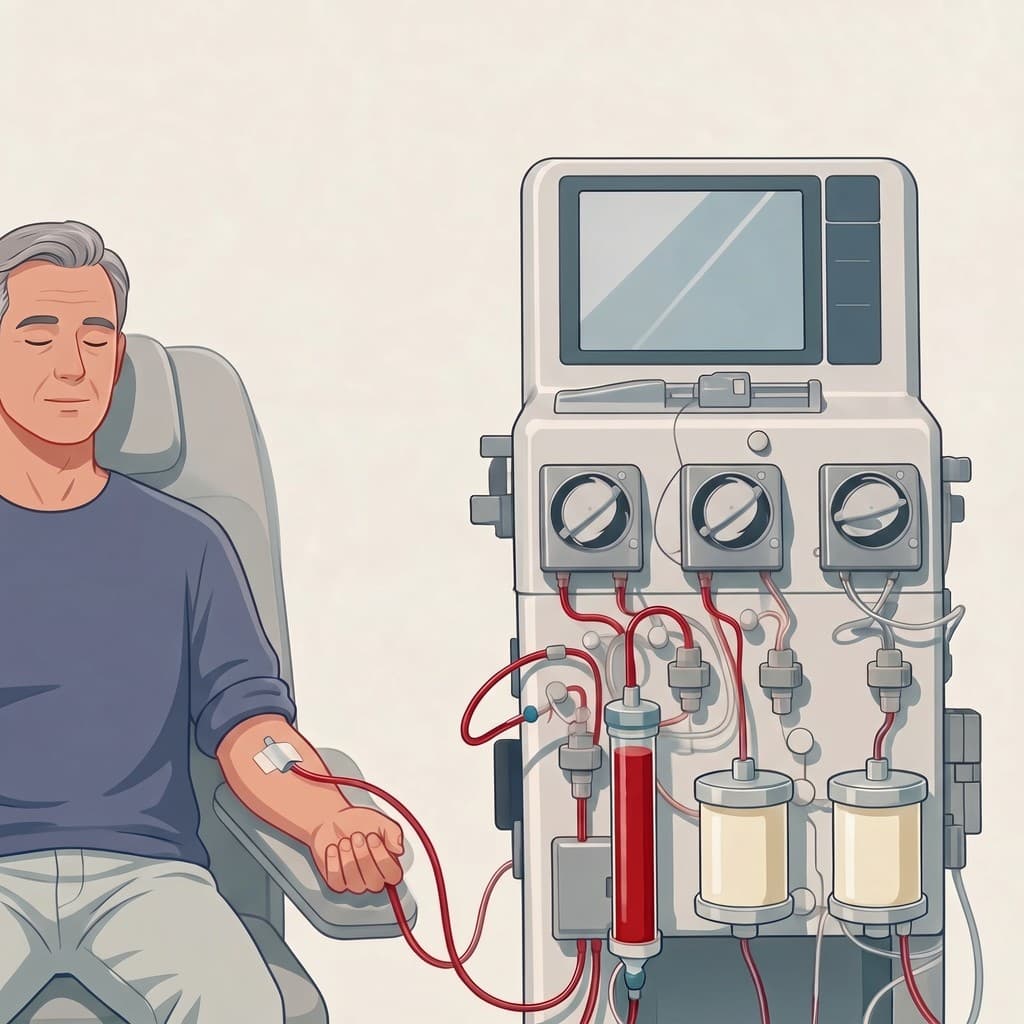
See the evidence →Like dialysis, but tuned for cholesterol.
Blood is drawn through a simple IV while you relax in a recliner.
The system selectively binds and removes Lp(a), LDL, and ApoB.
The purified blood flows back to your body, with lower cholesterol, immediately.
Is this you?
If any of these match, it’s worth a conversation. We review your history, labs, and coverage to confirm eligibility.
Early heart disease in your family
Heart attack or stroke before 55 (men) or 65 (women).
High Lp(a) or familial hypercholesterolemia
Genetic cholesterol medication can't fully control.
Statins aren't enough
You're on maximum therapy and still above goal.
A prior cardiac event
You've had a heart attack or stroke and need more protection.
There’s another option. Let’s run your numbers.
Call us to talk through your history, labs, and insurance. Most consultations can be scheduled within the week.