The process, start to finish

How lipoprotein apheresis actually works

It works on the same principle as dialysis: your blood leaves your body, passes through a filter that removes one specific thing, and comes right back, cleaner than it left.

The circuit

Four steps, one continuous loop.

The whole circuit runs continuously while you sit in a recliner. Only a small volume of blood is outside your body at any given moment.

WHOLE BLOODPLASMA01DrawA small IV in each arm02SeparatePlasma is split from cells03FilterLp(a), LDL & ApoB bind out04ReturnClean blood flows backREMOVED FROM CIRCULATIONPURIFIED BLOOD RETURNS TO YOULp(a), LDL and ApoB particlesBlood leaving your bodyClean blood returning
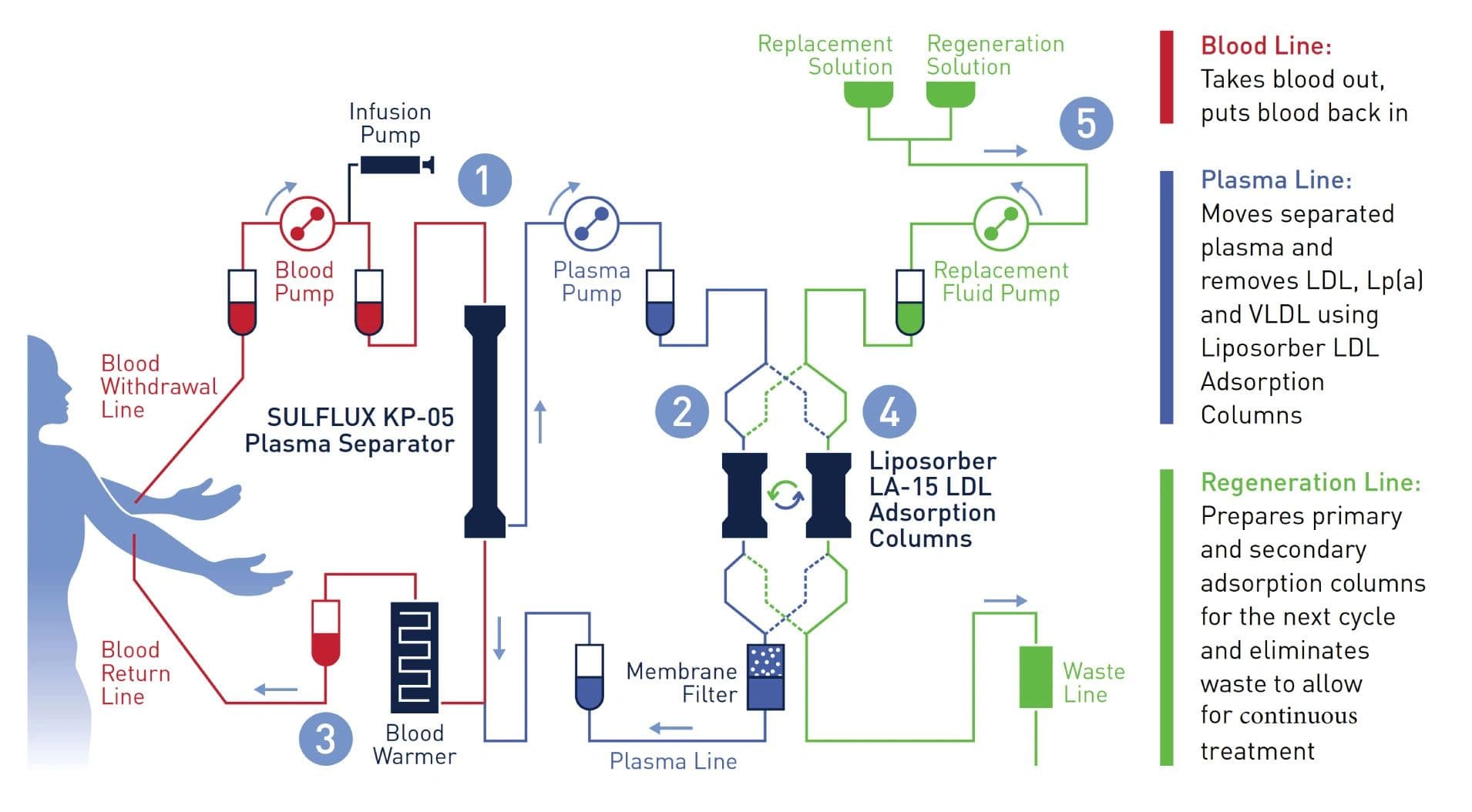
The same circuit, shown by the device manufacturer  ·  Kaneka Medical America
STEP 01

Draw

A nurse places a small IV in each arm: one to draw blood out, one to return it. If you already have a port, a central catheter or a fistula, we use that instead. This is the only part most patients feel.

STEP 02

Separate

The machine gently separates your plasma (the fluid that carries cholesterol) from your red and white blood cells.

STEP 03

Filter

The plasma passes through a column that selectively binds Lp(a), LDL, and ApoB and holds them, like a magnet for harmful particles.

STEP 04

Return

The cleaned plasma is recombined with your blood cells and returned through the IV in your other arm, continuously.

Selective by design

It removes the harmful particles and leaves the rest alone.

This is what makes apheresis different from a broad “blood cleaning.” The column is engineered to bind apolipoprotein-B particles specifically. Your red blood cells, platelets, immune proteins, and HDL (“good”) cholesterol pass through and return to you. Because the removal is physical rather than metabolic, the drop is immediate, measurable in your labs the same day.

Diagram of the apheresis circuit: the blood line carries blood out and back, the plasma line separates plasma and passes it through the adsorption columns that remove LDL, Lp(a) and VLDL, and the regeneration line prepares the columns for the next cycle.
The circuit in detail: plasma separator, adsorption columns and regeneration line
By the numbers

What one session does.

Per-session facts
Reduction per session65–85% of Lp(a), LDL, and ApoB removed from circulation
Session lengthTwo to four hours, seated in a reclining chair
FrequencyTypically every one to two weeks, ongoing
Blood outside the bodyOnly a small volume at any given moment, since the circuit is continuous
RecoveryMost patients return to normal activity the same day
SettingOutpatient clinic, monitored by our nursing team throughout
Levels rebuild between sessions, which is why apheresis is ongoing therapy, not a one-time fix.

Why it has to be repeated

Your body keeps producing Lp(a) and LDL at the rate your genetics dictate. A session clears what is circulating right now; over the following days levels climb back toward baseline. Treating on a regular schedule keeps your average exposure far lower over time, and it is that cumulative exposure that drives plaque and cardiac risk.

Think of it the way you would think of dialysis or regular blood pressure control: the benefit comes from consistency, not from any single visit.

See what a treatment day looks like →

Begin / consultation

Have questions about the process? Ask us directly.

We are happy to walk you through the circuit, the machine, and what you would feel, before you commit to anything.