No-option PAD and wounds that will not close
If your circulation is too poor for another stent or bypass and a wound is not healing, apheresis may be worth a conversation, particularly if you also carry high Lp(a) or inherited high cholesterol, because that combination is a recognised reason to treat.
A wound cannot heal without blood flow.
In advanced peripheral artery disease the arteries feeding the leg and foot narrow to the point where tissue no longer receives what it needs. Walking becomes painful, then pain arrives at rest, and eventually a small injury stops healing altogether. Once stents and bypass surgery have been tried and the vessels are still not carrying enough blood, the options narrow quickly, and the conversation often turns to amputation.
This is the group the research below is about: people whose disease is described as treatment-resistant, for whom conventional revascularization has been exhausted.
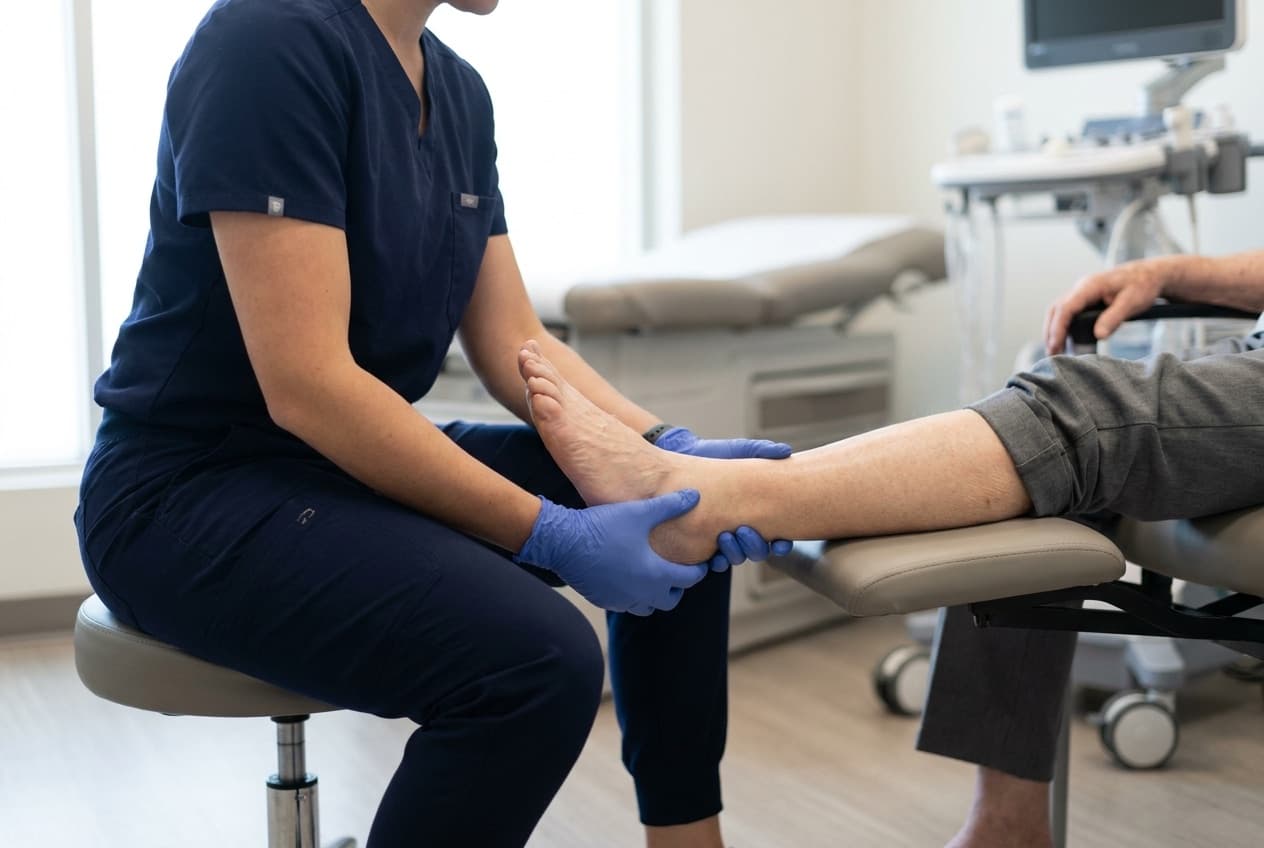
Why filtering blood might help a leg.
The interesting part of this research is that it involves patients whose cholesterol was already well controlled. Any benefit therefore cannot be explained by lowering LDL. It points instead to the other things a session changes about the blood itself.
Thinner blood, smaller vessels
Removing large lipoproteins and fibrinogen lowers plasma viscosity, which matters most in the smallest vessels, exactly where a wound bed gets its supply.
Vessel lining function
Endothelial function measured by reactive hyperemia improved after treatment in the study below, alongside a rise in antioxidant capacity.
Inflammatory and clotting factors
The column removes more than cholesterol. Fibrinogen and several inflammatory mediators come out with it.
One patient, one foot, complete closure.
Surgeons at Cedars-Sinai Medical Center reported a patient with severe PAD who was not a candidate for revascularization. A patient with severe PAD and non-healing lower-extremity wounds, deemed ineligible for revascularization. The left forefoot had gangrene with acute cellulitis; a transmetatarsal amputation had been performed but failed to heal because of ischemia.
| Study design | Single-patient case report, presented as a conference poster |
|---|---|
| Treatment | Lipoprotein apheresis every two weeks, given under the existing FDA indications for familial hypercholesterolemia and elevated Lp(a), alongside routine wound care. Wounds, lipid panels and Lp(a) were assessed weekly. |
| Outcome | Complete wound closure over 12 weeks of combined apheresis and wound care, with lipid reductions of up to 70% and reduced pain. No complications or adverse events were reported. The foot remained clinically healed and stable at three-month follow-up. |
- One patient. A case report can show that something is possible; it cannot show how often it happens
- No control group and no comparison against wound care alone, which was given at the same time
- Not a peer-reviewed journal publication, but a conference poster
- The number of apheresis sessions is reported inconsistently within the poster itself
What the LETS-PAD study found.
A Japanese research group treated 30 patients with refractory peripheral artery disease and normal cholesterol, then measured whether anything changed.
| Design | Single-arm prospective interventional study, with no control group |
|---|---|
| Who took part | 30 patients with conventional treatment-resistant PAD (Fontaine ≥ IIb, ABI < 0.7) who already had controlled lipids (total cholesterol ≤ 220 mg/dL, LDL-C ≤ 140 mg/dL) and were adjudicated refractory to revascularization |
| Protocol | Ten sessions, once or twice weekly, over a mean of 53 ± 20 days, using a dextran sulfate cellulose column (Liposorber LA-15) with 3,000–4,000 mL of plasma processed per session |
| Ankle-brachial index | 0.60 ± 0.09 → 0.65 ± 0.13 (p = 0.023) |
| Vascular quality of life (VascuQOL) | 3.7 ± 1.1 → 4.6 ± 1.1 (p < 0.001) |
| Endothelial function (reactive hyperemia index) | 1.70 ± 0.74 → 2.34 ± 1.76 (p = 0.023) |
| Antioxidant capacity (BAP) | Rose over follow-up, reaching significance at 3 months |
What the LETS-PAD study does not show.
Any clinic can quote the encouraging half of a paper. These are the authors’ own stated limitations, and they matter more than the numbers above.
- Single-arm design with no control group, so the improvements cannot be attributed to apheresis alone
- A placebo effect cannot be excluded for the symptom and quality-of-life measures
- No correlation was found between the ABI/quality-of-life gains and the endothelial or oxidative-stress markers, so the mechanism remains unclear
- Ulcer healing was not an endpoint; only 11 of the 30 patients had ulceration or gangrene
- 70% of participants were on maintenance hemodialysis and 96.7% had chronic kidney disease, which limits how far the findings generalise
- Follow-up was short
Encouraging evidence is a reason to ask questions, not a reason to promise results.
The criteria the researchers used.
These describe who was enrolled in the LETS-PAD study, which is a different question from whether you meet the criteria for treatment here. They are included so you and your vascular specialist can see whether your situation resembles the group that was investigated.
| Disease severity | Fontaine classification ≥ IIb: moderate-to-severe claudication, rest pain, or ulceration |
|---|---|
| Ankle-brachial index | Below 0.7 |
| Prior treatment | Refractory to conventional revascularization, adjudicated by an independent committee |
| Lipid levels | Already controlled, at total cholesterol ≤ 220 mg/dL and LDL-C ≤ 140 mg/dL |
| Age | 20 to 79 years |
Have you had your Lp(a) measured?
It matters more here than people expect. If you have poor circulation and elevated Lp(a) or inherited high cholesterol, you may meet the established criteria for treatment, and that is a different, much clearer conversation than the research above.
It is a single blood test, and it is not part of a standard cholesterol panel, so it has to be ordered specifically. Many patients with advanced vascular disease have never had it done.
Bring your vascular specialist into it.
We will review your labs and your history and tell you plainly whether you meet criteria, including when the answer is no. Any decision about your limb stays with your vascular surgeon; we work alongside them, not around them.
Questions about PAD and apheresis?
We would rather have a fifteen-minute conversation about whether this fits your situation than have you wonder.